









 My Account
  My Bag
  My Wishlist




Up to 20% Off Sitewide.
-
 How to buy an Engagement Ring
-
 Ring Types
-
 Diamond Color Scale
-
 Diamond Clarity Scale
-
 Key Points about Carat Weight
-
 Diamond Cut & Proportions
-
 Natural Diamonds
-
 Symmetry & Polish
-
 Labgrown Diamonds
-
 Fancy Color Diamonds
-
 Ring Settings
-
 Laser Inscription: Security & Peace of Mind
-
 Repairs & Ring Resizing
How to buy an Engagement Ring
Here's a step-by-step guide to buying an engagement ring
Set a Budget
Determine how much you're willing to spend. This will guide your choices and ensure you stay within your financial limits.
Understand the 4 Cs
Consider Lab-Grown Diamonds
Choose a Ring Style
Select the Diamond or Gemstone
Choose a Setting
Consider Certification
Verify Return and Warranty Policies
Make the Purchase
Plan the Proposal
Diamond Color Scale
The standardized grading scale to assess diamond color, which ranges from D to Z

D
E
F
G
H
I
J
K
L
M
TIPS
WATCH AND LEARN MORE ABOUT DIAMOND COLOUR
Diamond Clarity Scale
Clarity Comparison
Compare diamond clarities side by side and see the difference up close!


Diamond clarity refers to the evaluation of tiny imperfections, both on the surface (blemishes) and within the stone (inclusions). These factors play a significant role in determining a diamond's overall quality and value. Clarity grades are assigned based on the number, size, position, nature, and visibility of these imperfections, with diamonds that have fewer or less noticeable flaws being more valuable.
When selecting a diamond, it's crucial to choose one free from inclusions that could affect its beauty or durability. Opting for diamonds graded “VS2” or higher ensures you'll have a stone without visible flaws to the naked eye. While diamonds with an SI clarity grade can provide excellent value, it's wise to have them reviewed by one of our diamond specialists to confirm they maintain a clean appearance.
Industry average for Labgrown diamonds are VVS2 & VS1.
Industry
average for Natural Diamonds are VS2 & SI1.
| Clarity Grade | Percentage of Purchases (Lab-Grown) | Percentage of Purchases (Natural) |
|---|---|---|
| FL (Flawless) | 2-5% | Less than 1% |
| IF (Internally Flawless) | 10-15% | 2-3% |
| VVS1-VVS2 (Very Very Slightly Included) | 30-40% | 5-7% |
| VS1-VS2 (Very Slightly Included) | 35-40% | 25-30% |
| SI1-SI2 (Slightly Included) | 10-15% | 35-40% |
| I1-I2-I3 (Included) | Less than 1% | 20-25% |
WATCH AND LEARN MORE ABOUT DIAMOND CLARITY
Diamond Cut & Proportions

THE IMPORTANCE OF DIAMOND CUT
The cut of a diamond is the most significant factor affecting its brilliance, fire, and overall sparkle. While many think of cut as the shape of a diamond (like round, oval, or princess), it actually refers to how well the diamond’s facets are proportioned and angled to interact with light.
A well-cut diamond ensures light enters the stone, reflects internally, and exits through the top, creating a stunning display of brightness and sparkle. On the other hand, a poorly cut diamond may allow light to escape through the sides or bottom, making it look dull.
WHERE TO FIND IT ON A DIAMOND REPORT:
On grading reports from reputable organizations like International Gemological Institute (IGI) or the Gemological Institute of America (GIA), the cut grade is prominently listed. The diamond cut scale ranges from Excellent to Poor for round brilliant cuts, For non-round shapes (fancy cuts), cut grades removed from the diamond report and are replaced by evaluations of proportions, symmetry, and polish
UNDERSTANDING DIAMOND PROPORTIONS
Proportions describe the relationships between a diamond’s dimensions, such as its table size, depth, crown height, pavilion depth, and girdle thickness. These measurements are essential because they determine how light moves through the diamond. When proportions are ideal, light reflects and refracts efficiently, maximizing the stone’s brilliance and sparkle. The most important

Key proportional aspects to consider:
WHERE TO FIND IT ON A DIAMOND REPORT:
Both GIA and IGI reports include a “Measurements” or “Proportions” section, detailing depth percentage, table percentage. These numbers are critical to evaluate if the diamond’s cut achieves its intended brilliance.
HERE IS A CHEAT SHEET FOR THE Best Diamond Proportions for Every Diamond Shape !

SHALLOW, DEEP, AND IDEAL CUT DIAMONDS: KEY DIFFERENCES

WATCH AND LEARN MORE ABOUT DIAMOND CUT
Natural Diamonds
Natural diamonds are crystalline forms of carbon that are created deep within the Earth's mantle under extreme heat and pressure. They are composed almost entirely of carbon atoms arranged in a crystal structure called a diamond cubic lattice, which gives them their remarkable hardness and unique optical properties.
FORMATION
Natural diamonds form over billions of years at depths of about 140 to 190 kilometers (87 to 118 miles) beneath the Earth's surface, where temperatures are around 1,000°C to 2,000°C (1,832°F to 3,632°F) and pressures are about 725,000 to 870,000 pounds per square inch. Under these conditions, carbon atoms bond in a tetrahedral structure, resulting in the diamond's characteristic hardness.
CHARACTERISTICS
MINING AND DISTRIBUTION
Natural diamonds are typically mined from kimberlite or lamproite volcanic pipes, which are deep-rooted volcanic formations. Major diamond-producing countries include Russia, Botswana, Canada, and Australia. Once mined, diamonds are sorted, cut, and polished to enhance their appearance before being sold as gemstones.

Symmetry & Polish

SYMMETRY: A KEY TO UNIFORM SPARKLE
Symmetry refers to the precision of the diamond’s facet alignment. A diamond with excellent symmetry will evenly reflect and distribute light across its surface, ensuring consistent brilliance. Misaligned or unevenly sized facets can cause light to reflect improperly, resulting in dark areas or an uneven sparkle.
Symmetry is graded on both IGI and GIA reports, typically as part of the overall Cut Quality or in a section for Polish and Symmetry. The grades range from Excellent to Poor, with Excellent symmetry indicating facets that are perfectly aligned for maximum light performance.
POLISH: THE FINAL TOUCH ON A DIAMOND’S BEAUTY
Polish refers to the smoothness of a diamond’s surface, ensuring light passes through and reflects without disruption. A well-polished diamond enhances brilliance, fire, and overall sparkle.
Graded by IGI and GIA, polish ratings range from Excellent (flawless under magnification) to Poor (visible imperfections that affect sparkle).
WHERE TO FIND IT ON A DIAMOND REPORT:
Look for the Polish Grade in the “Finish” section of a diamond report to ensure your diamond shines at its best!
Labgrown Diamonds
Lab-grown diamonds, also known as synthetic or cultured diamonds, are diamonds that are created in a laboratory rather than being mined from the earth. These diamonds have the same physical, chemical, and optical properties as natural diamonds because they are made of the same material: carbon atoms arranged in a crystal structure
HOW THEY ARE MADE
Lab-grown diamonds are typically created using one of two methods:
PROPERTIES

IDENTIFICATION
While lab-grown diamonds are identical to natural diamonds in every way and form, they can only be distinguished using advanced equipment uses spectroscopy to identify the presence elements like nitrogen or boron. Humans can't detect these minute differences without this technology.
DIAMOND DETECTION PEN
While diamond pens were once a method for distinguishing diamonds from simulants, they are no longer sufficient in today's market because:
Modern jewelry professionals need to use multi-faceted testing methods, like spectroscopy or fluorescence analysis, to ensure accurate identification of diamonds and their origins.
COST AND ETHICS
In summary, lab-grown diamonds offer a sustainable and affordable alternative to natural diamonds without compromising on quality or appearance.
Fancy Color Diamonds
Fancy color diamonds are natural diamonds or lab grown diamonds that exhibit intense and distinct colors other than the traditional colorless or near-colorless hues. Unlike most diamonds, which are valued based on their lack of color, fancy color diamonds are prized for their vibrant and rare colors. These colors can include:
- Yellow or Orange
- Pink or Red
- Blue
- Green
- Purple
- Brown
- Black
The color in these diamonds is caused by various factors:
- Yellow and Orange : Caused by the presence of nitrogen.
- Pink and Red : The exact cause is not fully understood, but it is believed to be due to structural anomalies within the diamond's crystal lattice.
- Blue : Resulting from the presence of boron.
- Green : Typically caused by exposure to natural radiation.
- Brown : Often due to distortions in the diamond's crystal structure.
- Black : Usually contains numerous dark inclusions or graphite.


Fancy color diamonds are graded on a different scale compared to colorless diamonds. The intensity of the color is a key factor in determining the value, with categories like Fancy Light, Fancy, Fancy Intense, and Fancy Vivid, where Fancy Vivid diamonds usually command the highest prices.
These diamonds are rare and can be more expensive than colorless diamonds, especially when the color is intense and the diamond is free of inclusions.
ring settings
When choosing an engagement ring, the "setting" refers to the way the gemstone (usually a diamond) is mounted or held in place on the ring. The setting not only affects the appearance of the ring but also the security of the gemstone. Here are some of the most common types of engagement ring settings:
Prong Setting
Bezel Setting
Pavé Setting
Halo Setting
Channel Setting
Tension Setting
Bar Setting
Flush Setting (or Gypsy Setting)
Cathedral Setting
Vintage/Antique Setting
Each setting style has its own unique appeal and suits different preferences and lifestyles. When choosing a setting, consider factors like how much protection you want for the gemstone, how much maintenance you're willing to do, and your personal style.
Engagement Ring Types
Engagement rings come in various styles and designs, each with unique characteristics that cater to different tastes and preferences. Here are some of the most popular types of engagement rings:

Solitaire Engagement Rings

Halo Engagement Rings

Pavé Engagement Rings

Sidestone Engagement Rings

Three-Stone Engagement Rings
key points about carat weight
THE 4'CS - CARAT WEIGHT
In the context of the 4 C's of diamonds, "carat weight" refers to the measurement of a diamond's weight. It is one of the four key factors that determine a diamond's value, along with Cut, Color, and Clarity.

Laser Inscription: Security & Peace of Mind
Every diamond we offer comes with a microscopic laser inscription on its girdle—a unique identifier that ensures your diamond is one of a kind. This discreet marking matching the diamond’s certification number allows you to verify its authenticity at any time. Whether for insurance purposes or simply for your own peace of mind, you can always check this inscription under magnification to confirm you’re holding the exact diamond you purchased. A small detail with a big impact, it adds an extra layer of security and confidence to your investment.
Repairs & Ring Resizing – Donj Jewellery
At Donj, our minimum charge for any repair or resizing service is $85 plus HST. If you’re an existing Donj client you’re eligible for a reduced minimum fee of $75+tx
If your ring was originally made by Donj, please book a drop-off appointment at In Store - Repair, Sell Gold Appointment 📍 LAVAL - Donj Jewellery. Rings crafted by Donj include a complimentary resizing within the first year of purchase—up or down by one size.
If your item was not made by Donj, please complete the form at the bottom of this page and a member of our team will follow up. Please note that not all rings can be safely resized. Certain designs or gemstone types such as emeralds may require unsetting and resetting during resizing, which comes with an additional charge.
Important Details:- We do not offer resizing for rings that are less than 1.5mm in width, or for those made from vermeil or gold-filled materials, which are typically found in mass-produced fashion jewelry.
- Our workshop rate for 2025 is $175 per hour, calculated in 15-minute increments. This rate covers labour only and does not include materials, parts, or services like engraving or plating. Minimum charges still apply.
- Some rings may be able to go up one size through stretching, depending on the ring's condition and design. This is assessed on a case-by-case basis.
- Gemstones other than diamonds, sapphires, and spinels can be vulnerable to heat during resizing. In such cases, we will remove the stone before resizing and re-set it afterward. The cost for this service is $95 for stones under 0.50 carats and $125 for larger stones.
- If we determine that your ring cannot be resized, we'll explain the reasons and suggest any available alternatives.
- Donj uses white gold alloyed with palladium, following European standards. In contrast, most North American white gold contains nickel and is plated with rhodium to achieve a bright white finish. If your jewelry has rhodium plating, it may require re-plating after service. This is priced at $125, or $75 if the piece was made by Donj.
- Specialty finishes (such as a satin texture) are not included in base repair pricing and will be re-applied at the rates listed in our Made to Order section.
- For rings made with a combination of metals (e.g., 14K & 18K gold, or gold and platinum), pricing will reflect the higher-value metal.
| Cost to Resize 18K Yellow, Rose or Nickel-White Gold Rings | ||||
| Ring Width | Number of Gems/Diamonds | |||
| 1mm to 3mm | 0-4 | 5-20 | 21-35 | 36-50 |
| Sizing down/making smaller | $60 | $95 | $100 | $115 |
| up to 1 size higher | $90 | $120 | $130 | $175 |
| Each add size | $31 | $31 | $31 | $31 |
| 3mm+ to 5mm | 0-4 | 5-20 | 21-35 | 36-50 |
| Smaller* | $70 | $90 | $105 | $125 |
| up to 1 size higher | $120 | $145 | $175 | $180 |
| Each add size | $53 | $53 | $53 | $53 |
| 5-8mm | 0-4 | 5-20 | 21-35 | 36-50 |
| Smaller* | $75 | $99 | $115 | $130 |
| up to 1 size higher | $160 | $183 | $200 | $215 |
| Each add size | $79 | $79 | $79 | $79 |
| Cost to Resize 14K Yellow, Rose or Nickel-White Gold Rings | ||||
| Ring Width | Number of Gems/Diamonds | |||
| 1mm-3mm | 0-4 | 5-20 | 21-35 | 36-50 |
| Smaller* | $55 | $80 | $95 | $110 |
| up to 1 size higher | $80 | $105 | $120 | $155 |
| Each add size | $27 | $27 | $27 | $27 |
| 3mm+ to 5mm | 0-4 | 5-20 | 21-35 | 36-50 |
| Smaller* | $60 | $95 | $100 | $115 |
| up to 1 size higher | $100 | $130 | $145 | $160 |
| Each add size | $40 | $40 | $40 | $40 |
| 5mm+ to 8mm | 0-4 | 5-20 | 21-35 | 36-50 |
| Smaller* | $65 | $90 | $115 | $125 |
| up to 1 size higher | $130 | $155 | $170 | $185 |
| Each add size | $58 | $58 | $58 | $58 |
| Cost to Resize Platinum or 18K Palladium White Gold Rings | ||||
| Ring Width | Number of Gems/Diamonds | |||
| 1mm-3mm | 0-4 | 5-20 | 21-35 | 36-50 |
| Smaller* | $85 | $110 | $125 | $140 |
| up to 1 size higher | $140 | $165 | $180 | $195 |
| Each add size | $51 | $51 | $51 | $51 |
| 3mm+ to 5mm | 0-4 | 5-20 | 21-35 | 36-50 |
| Smaller* | $95 | $120 | $135 | $150 |
| up to 1 size higher | $200 | $225 | $245 | $260 |
| Each add size | $98 | $98 | $98 | $98 |
| 5mm+ to 8mm | 0-4 | 5-20 | 21-35 | 36-50 |
| Smaller* | $110 | $135 | $150 | $165 |
| up to 1 size higher | $260 | $280 | $295 | $310 |
| Each add size | $132 | $132 | $132 | $132 |
| Cost to Resize Silver Rings | ||||
| Ring Width |
Number of Gems/Diamonds |
|||
| 1mm-3mm | No Gems/Diamonds | With Gems/Diamonds | ||
| Smaller* | $45 | $65 | ||
| 1 size higher | $60 | $75 | ||
| Each add size | $8 | $8 | ||
| 3-5mm | No Gems/Diamonds | With Gems/Diamonds | ||
| Smaller* | $60 | $70 | ||
| 1 size higher | $70 | $80 | ||
| Each add size | $9 | $9 | ||
| 5mm+ to 8mm | No Gems/Diamonds | With Gems/Diamonds | ||
| Smaller* | $70 | $80 | ||
| 1 size higher | $80 | $90 | ||
| Each add size | $10 | $10 | ||
*All prices for sizing rings smaller include a credit for any metal removed from your ring. We do not return metal from repairs or re-sizings. Metals from our manufacturing and repair processes are recycled.Restringing Pearls or other Beaded Necklaces
$150 for a 16" Strand + $20 for each additional inch up to 20" + $10 per inch thereafter. $85 for any Bracelet 8" or less + $20 for each additional inch Replacement clasps in 18K gold or platinum will be quoted.
SHOP WITH CONFIDENCE
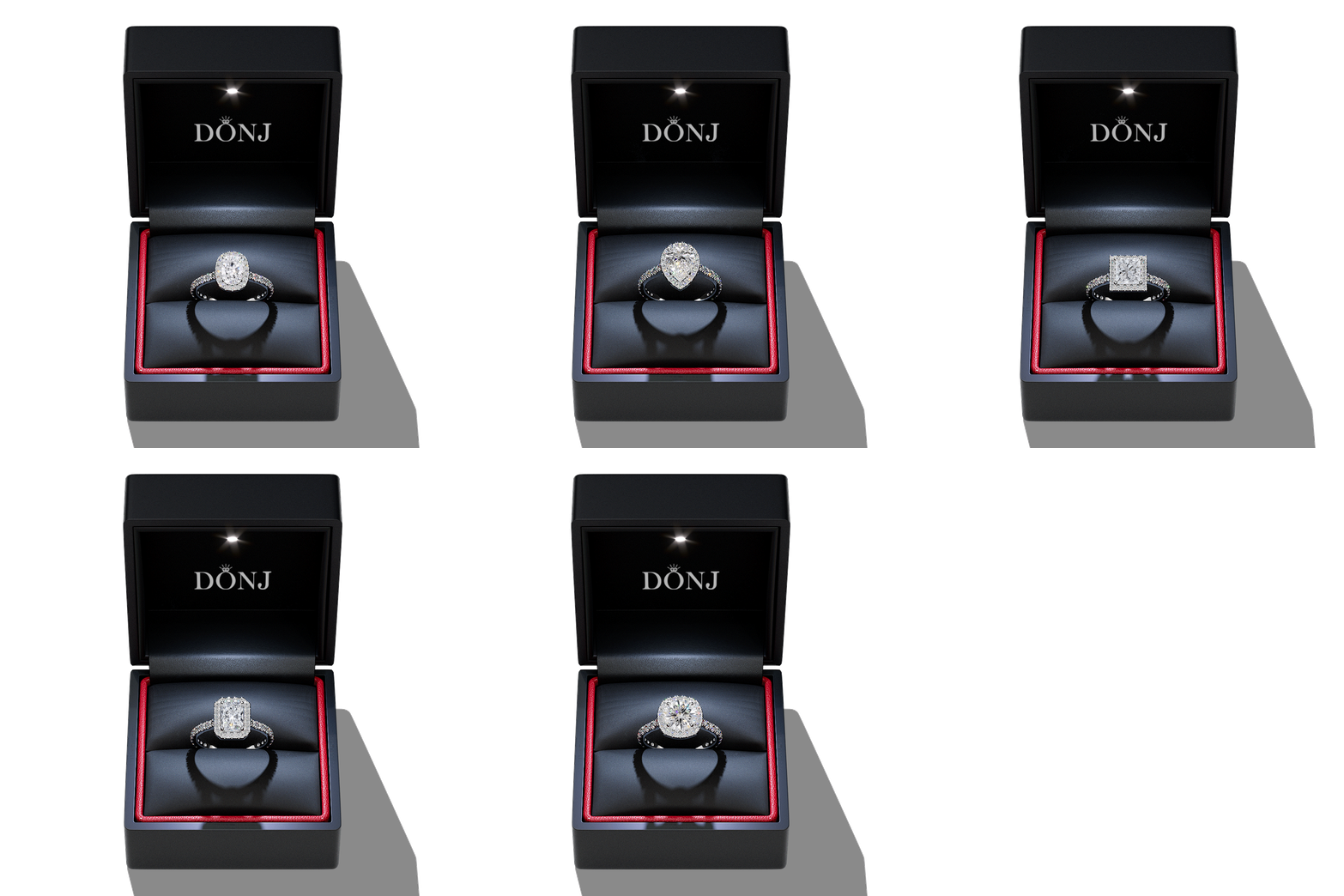
QUALITY PACKAGING WITH AN LED LIGHT BOX
LED LIGHT BOX
45 DAY HASSLE FREE RETURNS
45 DAY HASSLE FREE RETURNS
CERTIFIED DIAMOND REPORT
DIAMOND REPORT
INSURANCE APPRAISAL REPORT
APPRAISAL REPORT
LIFETIME WARRANTY
LIFETIME WARRANTY
FREE SHIPPING
FREE SHIPPING